Best Multivitamin for Women Over 40: What to Look for (And What to Skip)
If you’ve been grabbing the same multivitamin off the shelf for years, it might be time to take a closer look at the label. What your body needed at 25 is not what it needs at 40, 45, or 50 — and most generic multivitamins haven’t caught up.
The good news: once you know what to look for, picking the right multivitamin becomes a lot less overwhelming. This guide breaks it all down.
Why women over 40 need a different multivitamin
After 40, your body goes through real hormonal and metabolic shifts. Estrogen starts to decline. Bone density becomes a concern. Energy production slows. Absorption of key nutrients like B12 and magnesium decreases.
A multivitamin designed for “adults” or even “women” often misses these specific needs — either under-dosing the nutrients you actually need most, or including iron at levels that are no longer appropriate after perimenopause.
The right multivitamin for this stage of life should support bone health, energy, hormone balance, and heart health — not just fill in random nutritional gaps.
Key nutrients to look for
Vitamin D3 + K2
These two work as a team. Vitamin D3 helps your body absorb calcium. Vitamin K2 directs that calcium into your bones — not your arteries. After 40, this combination becomes critical for long-term bone and heart health. Look for at least 1,000–2,000 IU of D3 and 90–120 mcg of K2 (as MK-7).
Magnesium (as glycinate or malate)
Magnesium is involved in over 300 body functions — sleep, muscle recovery, mood, and energy. Most women over 40 are deficient and don’t know it. The form matters: magnesium glycinate or malate is absorbed best. Avoid magnesium oxide — it’s cheap but poorly absorbed.
Also read: Best Magnesium Supplement for Women Over 40: What Nobody Tells You
Vitamin B12 (as methylcobalamin)
B12 absorption decreases with age, especially after 40. Low B12 shows up as fatigue, brain fog, and mood changes — symptoms that are easy to overlook or blame on stress. Look for methylcobalamin (the active form), not cyanocobalamin.
Folate (as methylfolate, not folic acid)
Many women have a genetic variation that makes it hard to convert folic acid into usable folate. After 40, methylfolate (the active form) is a smarter choice. It supports heart health, mood, and cognitive function.
Calcium — but less than you think
Most multivitamins include calcium, but you actually don’t need a huge dose in your multivitamin if you’re eating dairy or leafy greens. Too much supplemental calcium without K2 can cause more harm than good. A modest 200–300mg in your multi is plenty.
Iron — probably not needed
After perimenopause or menopause, most women no longer need iron supplementation. In fact, excess iron can be harmful. Unless your doctor has confirmed you’re deficient, choose an iron-free multivitamin.
Top multivitamin picks for women over 40
Best overall — Ritual Essential for Women 40+
Ritual is one of the few brands built specifically around the nutrients women over 40 actually need — D3, K2, magnesium, methylfolate, and methylated B12. It’s iron-free, third-party tested, and uses highly absorbable forms. The delayed-release capsule is designed to be gentle on an empty stomach.
Best budget-friendly — Garden of Life Vitamin Code Women 40+
Made from whole foods, this multivitamin includes a broad spectrum of vitamins and minerals in food-based forms that are easier to absorb. It’s iron-free and includes probiotics and enzymes. A solid option if you want clean ingredients without a premium price tag.
Best for bone health — New Chapter Every Woman’s One Daily 40+
New Chapter ferments their nutrients for better absorption and includes a thoughtful blend of D3, K2, and plant-based calcium. If bone density is a top concern, this one is worth a look.
Best for energy — Thorne Women’s Multi 50+
Thorne is a trusted name in professional-grade supplements. This formula is heavy on B vitamins and antioxidants — great if fatigue and energy are your main concerns. It’s also completely iron-free.
What to avoid on the label
Not all multivitamins are created equal. Here’s what to watch for:
- Folic acid instead of methylfolate — harder for many women to use effectively
- Cyanocobalamin instead of methylcobalamin — a cheaper, less active form of B12
- Magnesium oxide — poorly absorbed and often causes digestive upset
- Added iron (unless prescribed) — unnecessary and potentially harmful after menopause
- Artificial colors, dyes, or fillers — look for clean labels
- Megadoses of fat-soluble vitamins (A, D, E, K) — these accumulate in the body and too much can be harmful
How to get the most out of your multivitamin
Timing matters more than most people realize. Fat-soluble vitamins (A, D, E, K) absorb best when taken with a meal that contains fat. B vitamins can be energizing — some women do better taking them in the morning rather than at night.
Also worth knowing: a multivitamin is a foundation, not a fix. If you’re significantly deficient in something like vitamin D or magnesium, you’ll likely need a separate targeted supplement to get your levels up — a multi alone won’t be enough.
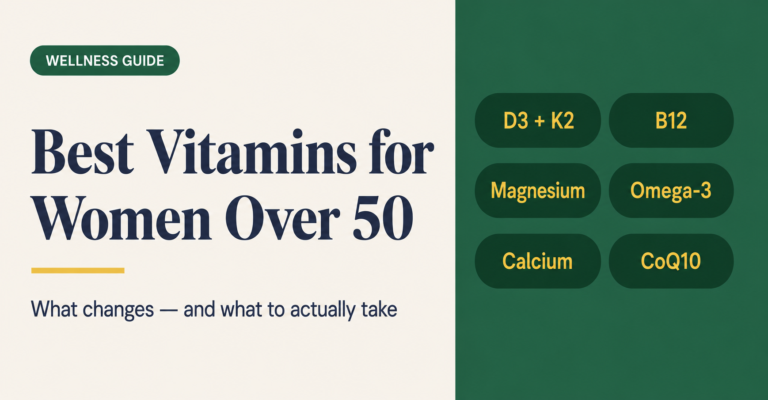
Also read: Best Vitamins for Women Over 50: What Changes and What to Take
What to discuss with your doctor
Before starting any new supplement, it’s worth asking your doctor for a basic blood panel: vitamin D, B12, magnesium, and ferritin (iron stores). These four tests give you a clear picture of where your actual gaps are — so you’re supplementing with purpose, not guesswork.
Some supplements also interact with medications. If you’re on blood thinners, thyroid medication, or any long-term prescription, check with your doctor before adding new supplements to your routine.
The bottom line
The best multivitamin for women over 40 isn’t the cheapest one or the one with the most ingredients — it’s the one that delivers the right nutrients in forms your body can actually use.
Start with D3 + K2, methylated B12, methylfolate, and magnesium glycinate. Choose iron-free. Read the forms, not just the amounts.
Your 40s can be some of your strongest years — with the right foundation underneath them.
You might also like:
– Best Vitamins for Women Over 50: What Changes and What to Take
– Best Magnesium Supplement for Women Over 40: What Nobody Tells You
– Best Collagen Supplement for Women Over 40: Does It Actually Work?
– What Health Screenings Every Woman Over 40 Actually Needs (And When)
“See all my vetted picks in one place → My Picks”
Disclaimer: This post contains affiliate links. If you purchase through these links, I may earn a small commission at no extra cost to you. I only recommend products I genuinely believe in.