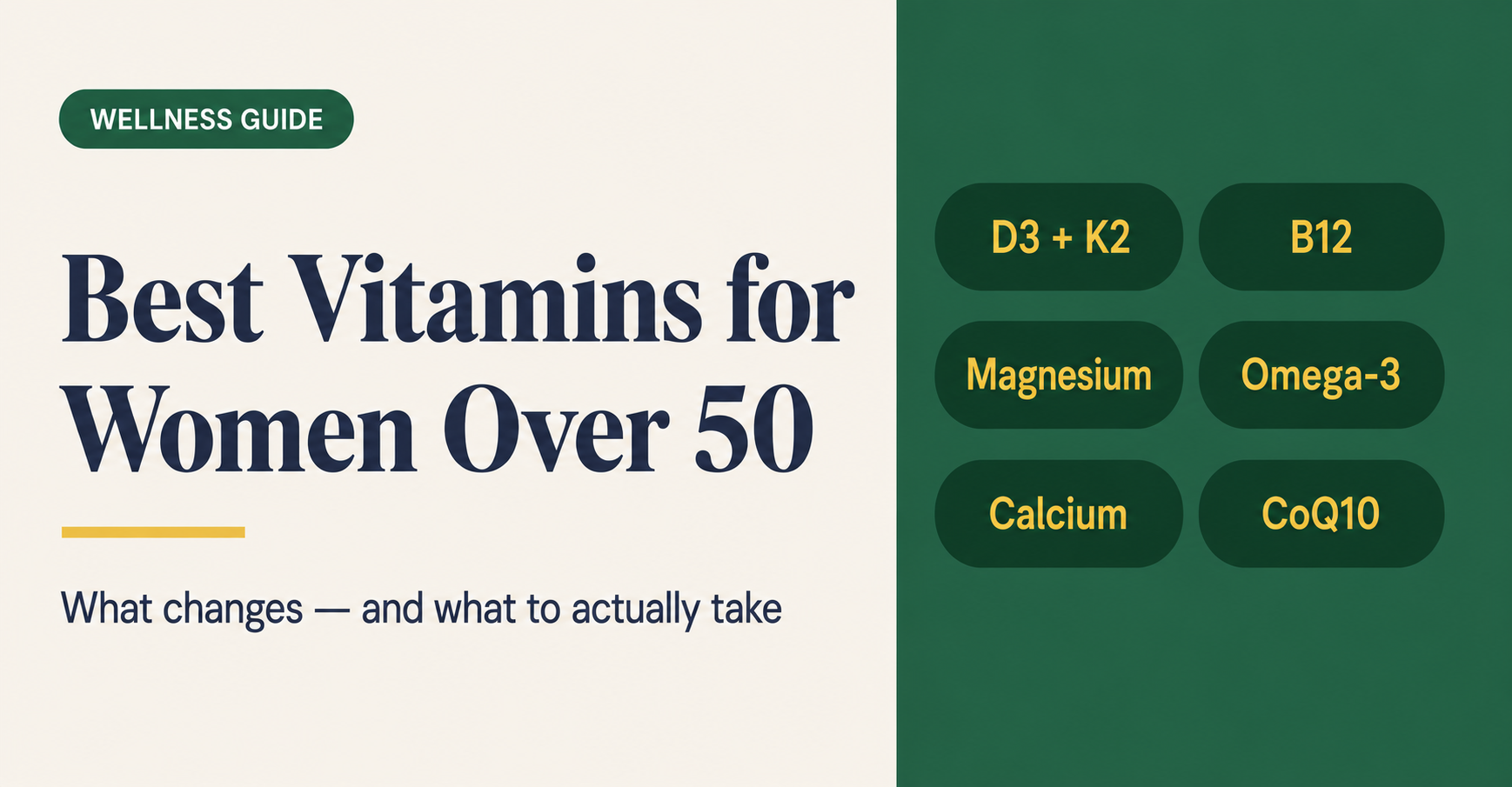
Best Vitamins for Women Over 50: What Changes and What to Take
Turning 50 is one of those invisible finish lines that your body seems to know about before you do. Suddenly the multivitamin you’ve been taking since your 30s might not be cutting it anymore — and the deficiencies that were quietly building in your 40s are now making themselves loudly known. The good news? This is also the decade where smart supplementation can make one of the biggest differences in how you feel, think, and age.
But here’s the problem with most “women’s vitamins” on the market: they’re formulated for a generic woman, not for the specific hormonal, metabolic, and skeletal changes that happen after 50. Let’s look at what actually changes — and what your body genuinely needs more of now.
What changes in your body after 50
After menopause, estrogen drops significantly and stays low. This single shift triggers a cascade of changes: accelerated bone loss, reduced collagen production, changes in how you process nutrients, and a higher risk of cardiovascular issues. Your gut also absorbs certain nutrients — particularly B12, calcium, and vitamin D — less efficiently than it did before.
Think of your 50s as a nutritional reset. The supplements that support a 35-year-old woman are not the same ones that support a 52-year-old woman. The needs are genuinely different — and the gaps are bigger.
The essential vitamins and minerals after 50 — what the research says
Vitamin D3 + K2 — the bone and heart duo
After menopause, bone density drops significantly without estrogen’s protective effect. Vitamin D3 is essential for calcium absorption — but without K2, that calcium can end up in your arteries instead of your bones. D3 and K2 work as a team. Most women over 50 need 2,000–4,000 IU of D3 daily. Get your levels tested — deficiency is extremely common and completely fixable.
Vitamin B12 — brain and energy essential
After 50, your stomach produces significantly less acid, which is required to extract B12 from food. Sublingual methylcobalamin (the active form) bypasses this absorption issue entirely. Low B12 in your 50s is strongly linked to cognitive decline, fatigue, and mood issues.
Magnesium — sleep, bones, and heart health
Magnesium becomes even more critical after 50. It supports bone density alongside calcium, helps regulate blood pressure, and is essential for sleep quality. Most women over 50 are significantly deficient. Magnesium glycinate is the gentlest, most absorbable form for sleep and mood. Magnesium malate is better for energy and muscle function.
Omega-3 fatty acids — inflammation and brain
Post-menopause brings a significant increase in systemic inflammation — which drives joint pain, cognitive changes, and cardiovascular risk. Omega-3s (EPA and DHA specifically) are one of the most well-researched anti-inflammatory nutrients available. Aim for at least 1,000mg of combined EPA + DHA daily.
Calcium — but not how you think
Here’s the nuance most people miss: calcium supplements alone don’t prevent fractures — and high-dose calcium supplements without K2 may actually increase cardiovascular risk. The smarter approach is getting calcium primarily from food (dairy, leafy greens, sardines) while supplementing with D3 + K2 to optimize how your body uses the calcium you already eat. If supplementing, calcium citrate absorbs better than calcium carbonate after 50.
CoQ10 — the energy supplement most women overlook
CoQ10 is produced naturally in your cells to generate energy in the mitochondria. Production declines significantly after 40, and even more after 50. If you’re on a statin medication (which depletes CoQ10), supplementing is especially important. Ubiquinol form absorbs significantly better than ubiquinone — worth the extra cost after 50.
Top product picks for women over 50
Best overall multivitamin — Garden of Life mykind Organics Women 40+
Whole food based, certified organic, and specifically formulated for women in this life stage. Contains meaningful amounts of D3, B12, folate, and an iron-free formula. No synthetic binders or fillers. One of the cleanest multivitamins available on Amazon.
Best D3 + K2 combo — Sports Research Vitamin D3 + K2 with Organic Coconut Oil
2,000 IU of D3 paired with 100mcg of MK-7 K2 — the most bioavailable form. Suspended in organic coconut oil for better fat-soluble absorption. Third-party tested, non-GMO. One of the most consistently top-rated D3+K2 combinations on Amazon.
Best Omega-3 — Thorne Super EPA (concentrated fish oil)
High EPA concentration specifically — research shows EPA is more effective than DHA for mood, inflammation, and cardiovascular support. Molecularly distilled for purity, no fishy aftertaste, and NSF certified. If joint pain, mood, or heart health is a primary concern after 50, this is the fish oil worth paying for.
Best CoQ10 (Ubiquinol form) — Qunol Mega Ubiquinol CoQ10 100mg
Ubiquinol is the active, reduced form of CoQ10 that your body can use directly — absorption is significantly higher than standard ubiquinone, especially important after 50. Water and fat soluble for maximum bioavailability. Consistently one of the top-rated CoQ10 supplements on Amazon.
How to build your supplement routine without overwhelm
You don’t need to take everything at once. Start with the highest-impact essentials and add from there:
Step 1: Start with D3 + K2 — almost everyone over 50 is deficient and the impact is immediate and broad.
Step 2: Add magnesium glycinate at night — sleep improvements are often noticeable within the first week.
Step 3: Add B12 sublingual in the morning — especially if you experience brain fog or fatigue.
Step 4: Add Omega-3 with your largest meal — reduces inflammation and supports heart and brain health long-term.
Step 5: Consider CoQ10 if you’re on a statin or experience persistent low energy despite the above.
Also read: Best Magnesium Supplement for Women Over 40 — our full guide on types and dosing
Also read: Why You’re Always Tired After 45 — B12, iron, and thyroid explained
What to discuss with your doctor
Before adding a full supplement stack, ask for a baseline blood panel that includes: vitamin D (25-OH), B12 serum, ferritin, and a full thyroid panel. These four tests will tell you exactly where your biggest gaps are — so you’re supplementing with precision, not guesswork.
Also worth discussing: if you’re on any medications, some supplements interact. Omega-3s can thin blood slightly (relevant if you’re on blood thinners). K2 can interact with warfarin. Magnesium can interact with certain antibiotics. None of these are reasons to avoid supplements — they’re just reasons to have the conversation first.
Your 50s can be your strongest decade yet — with the right foundation. Start with D3 + K2 and magnesium this week. Two supplements. Massive impact. Build from there.
“See all my vetted picks in one place → My Picks”
Free Quiz
Not sure which supplements you actually need?
Answer 6 questions and get a personalized recommendation — free, no email required.
Take the free quiz →Disclaimer: This post contains affiliate links. If you purchase through these links, I may earn a small commission at no extra cost to you. I only recommend products I genuinely believe in.
───────────────────────── You might also like:
– Best Collagen Supplement for Women Over 40
– Best Magnesium Supplement for Women Over 40
– Best Protein Powder for Women Over 40
– Best Probiotic for Women Over 40
─────────────────────────