Best Protein Powder for Women Over 40: What to Look for and What to Skip
If you’ve ever stood in the supplement aisle staring at fifty nearly identical protein powder tubs and walked away empty-handed — this post is for you. Protein powder has become one of the most confusing supplement categories out there, with brands making bold claims and ingredient lists that require a chemistry degree to decode. But here’s what most brands won’t tell you: the protein powder that worked great for your 32-year-old self may not be the best choice for your body at 42 or 52.
After 40, your protein needs genuinely increase — and so does the importance of what’s in your powder and what isn’t. Let’s sort through the noise.
Why protein matters more after 40 — not less
Here’s something most women are surprised to learn: you actually need more protein after 40, not the same amount. Starting in your late 30s, your body becomes less efficient at using dietary protein to build and maintain muscle — a process called anabolic resistance. To get the same muscle-preserving effect, you need to consume more.
The current research for women over 40 suggests aiming for 1.2–1.6g of protein per kilogram of body weight daily. For a 150-pound woman, that’s roughly 82–109g of protein per day. A quality protein powder makes hitting that target dramatically easier.
Beyond muscle preservation, adequate protein after 40 supports: bone density, metabolism (protein has the highest thermic effect of any macronutrient), satiety and blood sugar stability, skin and collagen production, and immune function.
Which type of protein powder is right for you?
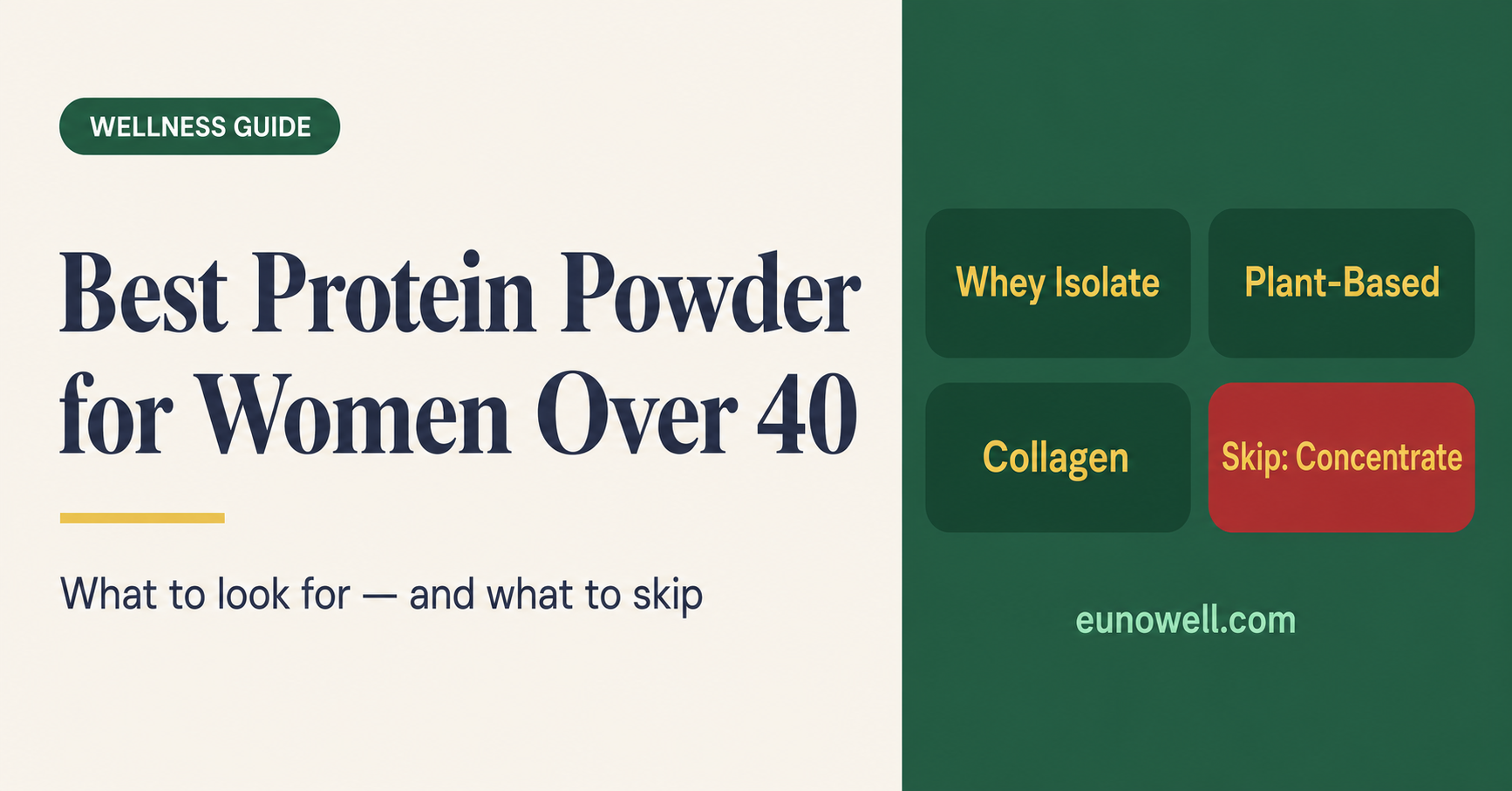
Whey isolate — best absorption
Fastest absorbing, complete amino acid profile, highest leucine content (key for muscle protein synthesis). Best for post-workout. Caveat: not suitable if you have dairy sensitivity, which becomes more common after 40.
Plant-based blends — best for digestion
Pea + rice protein together form a complete amino acid profile. Easier on digestion, no dairy, works well any time of day. Slightly lower leucine — aim for 25–30g per serving to compensate.
Collagen protein — best for skin + joints
Rich in glycine and proline — the building blocks of collagen. Not a complete protein for muscle building, but excellent added to smoothies alongside another protein source.
Whey concentrate — skip this one
Higher in lactose than isolate — more likely to cause bloating, which becomes more common after 40. Also more fillers and lower protein per serving than isolate.
What to look for on the label — your checklist
Before you buy any protein powder, flip it over and check these five things:
1. 20–30g protein per serving — less than 20g won’t effectively stimulate muscle protein synthesis after 40.
2. Under 5g of sugar — many “healthy” powders are loaded with sugar or artificial sweeteners that spike blood sugar and promote fat storage.
3. Third-party tested — look for NSF Certified, Informed Sport, or Banned Substances Control Group (BSCG) seals. This matters more than marketing claims.
4. Short ingredient list — if you can’t pronounce half the ingredients, put it back. Real food protein shouldn’t need 25 additives.
5. No proprietary blends — this means the manufacturer is hiding exact amounts of ingredients. Transparency matters when you’re putting something in your body daily.
Top protein powder picks for women over 40
Best overall (plant-based) — Orgain Organic Protein Powder
21g of organic pea, brown rice, and chia protein per serving. Certified organic, no artificial sweeteners, under 150 calories, and one of the best-tasting plant proteins available. Mixes easily, doesn’t clump, and won’t cause the bloating that whey can trigger after 40. One of Amazon’s consistently top-rated protein powders with tens of thousands of reviews.
Best whey isolate — Thorne Whey Protein Isolate
NSF Certified for Sport — one of the most rigorous third-party testing standards available. 21g of pure whey isolate per serving with minimal additives. If you tolerate dairy well and want the fastest-absorbing, highest-quality whey on the market, this is it. Particularly good post-workout when speed of absorption matters most.
Best for skin + muscle combined — Vital Proteins Collagen Peptides + Whey
Combines 25g of whey protein with collagen peptides in one scoop — giving you the muscle-building benefits of whey alongside the skin, joint, and gut benefits of collagen. A smart combination for women over 40 who want to address both muscle preservation and the visible signs of aging at the same time.
Best budget option — Garden of Life Sport Organic Protein
30g of certified organic plant protein per serving — one of the highest protein counts in the plant-based category. NSF Certified for Sport, completely vegan, and sweetened with stevia. Slightly grainier texture than Orgain but significantly higher protein per serving. Excellent value for the quality.
How and when to use protein powder for best results
Timing matters — but not in the way fitness culture often suggests. What matters most is total daily protein intake distributed across meals. Aim for 25–35g of protein at each of your three main meals.
A protein shake is most useful when it replaces a low-protein meal — like breakfast, where most women eat far too few grams to trigger muscle protein synthesis. A high-protein breakfast smoothie with one scoop of protein powder, half a banana, almond milk, and a handful of spinach delivers roughly 25–30g of protein and takes three minutes to make.
Also read: How to Lose Belly Fat After 40 — why protein is the key strategy most women miss
Also read: Best Vitamins for Women Over 50 — how to build your complete supplement routine
What to avoid — red flags on the label
Skip any protein powder that contains: artificial colors or flavors, high-fructose corn syrup or cane sugar as a primary sweetener, more than 10g of sugar per serving, or a proprietary blend that hides individual ingredient amounts.
Also worth knowing: many protein powders marketed specifically to women are simply underdosed versions of standard powders with pink packaging and a higher price tag. You don’t need a “women’s formula” — you need a clean, well-dosed product that hits your protein target.
More protein. Less confusion. Starting today. Pick one of the options above and add it to your morning routine this week. Your muscles, metabolism, and energy levels will thank you — usually within 2–3 weeks of consistent use.
Free Quiz
Not sure which supplements you actually need?
Answer 6 questions and get a personalized recommendation — free, no email required.
Take the free quiz →You might also like:
– Best Vitamins for Women Over 50: What Changes and What to Take
– Best Collagen Supplement for Women Over 40: Does It Actually Work?
– Best Magnesium Supplement for Women Over 40: What Nobody Tells You
– Best Probiotic for Women Over 40: Gut Health Changes Everything
“See all my vetted picks in one place → My Picks”
Disclaimer: This post contains affiliate links. If you purchase through these links, I may earn a small commission at no extra cost to you. I only recommend products I genuinely believe in.