The 15-Minute Evening Routine That Actually Helps You Sleep Better After 40
You’re in bed by 10pm. You’ve done everything right. And yet — you’re staring at the ceiling at midnight, your brain running through tomorrow’s to-do list like it’s auditioning for a Netflix drama. Sound familiar? Here’s the thing: after 40, your body’s relationship with sleep genuinely changes. Falling asleep isn’t just about being tired anymore. It’s about giving your nervous system the right cues at the right time — every single night.
The good news? You don’t need a 90-minute spa ritual to fix it. Fifteen focused minutes before bed can completely change how you sleep. Here’s the routine, step by step — and the products that make it even easier.
Why sleep gets harder after 40 (it’s not just in your head)
Between perimenopause, elevated cortisol, and a nervous system that’s been running on overdrive for decades, sleeping like you did at 30 takes a little more intention now. Progesterone — the hormone that naturally calms your brain — starts declining in your 40s. Melatonin production also slows down. And if you’re going through any kind of life transition — career shift, kids leaving home, health reset — your brain has even more to process at night.
The fix isn’t more hours in bed. It’s training your brain to shift gears before you even get there.
Think of your evening routine like a runway for sleep. Planes don’t just drop out of the sky — they need a long, gradual descent. Your brain works the same way.
The 15-minute routine — step by step
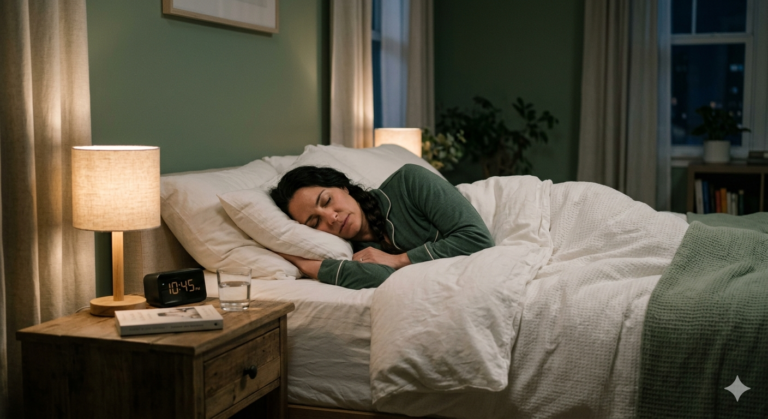
9:45 PM — Dim every light in the house
Bright light — especially blue light from phones and overhead LEDs — tells your brain it’s noon, not midnight. Dimming lights 60–90 minutes before bed is one of the single most effective sleep interventions backed by research. Use lamps instead of overhead lights, or swap to warm-toned bulbs. This one habit alone can add 30–45 minutes of quality sleep.
9:50 PM — Take your magnesium glycinate
If you read our magnesium post, you know this one. Magnesium glycinate taken 30–60 minutes before bed helps your nervous system downshift naturally. It’s the gentlest, most effective sleep supplement most women over 40 aren’t taking. Start at 200mg and work up to 400mg as needed.
9:55 PM — Do a 5-minute brain dump
Grab a notebook and write down everything sitting in your head — tasks, worries, ideas, tomorrow’s errands. This isn’t journaling. It’s more like clearing your browser tabs before shutting down the computer. Research from Baylor University found that writing a to-do list before bed helped people fall asleep significantly faster. Five minutes. That’s all it takes.
10:00 PM — Apply magnesium lotion + do a quick body scan
Magnesium lotion applied to your legs, feet, or shoulders gives you a topical boost while also forcing you to slow down and check in with your body. Pair it with a simple body scan — starting at your feet, consciously relaxing each muscle group upward. By the time you reach your shoulders, you’ll already feel calmer.
10:05 PM — Get into bed with one sensory cue
Your bedroom should feel like a sleep sanctuary, not a second office. Pick one consistent sensory cue that signals sleep: a silk pillowcase that feels cool against your face, a white noise machine that drowns out the neighborhood, or a sleep mask that blocks every last sliver of light. Consistency is the point — your brain learns to associate that cue with sleep over time.
Products that make this routine easier
Best for the routine — Ancient Minerals Magnesium Lotion
One of the most popular topical magnesium options on Amazon. Absorbs quickly, not greasy, and the act of massaging it in is relaxing in itself. Apply to legs or feet right before bed.
Best for blocking light — Alaska Bear Silk Sleep Mask
Lightweight, breathable, and actually stays on all night. One of the bestselling sleep masks on Amazon with thousands of five-star reviews. Complete darkness can increase melatonin production by up to 50%.
Best for blocking noise — LectroFan White Noise Machine
Ten fan sounds, ten white noise variations — no looping, no sudden restarts at 3am. Compact enough for travel. If you share a bedroom or live in a noisy neighborhood, this is a game-changer.
Best for the brain dump — Leuchtturm1917 Hardcover Notebook
A beautiful, well-made notebook makes the brain dump habit feel like a ritual instead of a chore. Numbered pages, a table of contents, and a lay-flat binding. When your journal feels good to use, you actually use it.
What to expect — a realistic timeline
Night one: you might feel a little calmer, mostly because you have a plan. That alone reduces anxiety around sleep.
Week one: falling asleep starts to feel less like a battle. The routine becomes a habit your body starts to recognize.
Week two to three: deeper sleep, fewer middle-of-the-night wake-ups, and waking up feeling more rested. This is when most women notice the real difference.
The key is doing it consistently — even on weekends. Your brain doesn’t know it’s Saturday. It just knows whether you gave it the right signals.
One more thing — your phone
No routine will fully work if your phone is on your nightstand. The blue light is one problem. But the bigger issue is what happens when you check it — a single stressful email or a late-night scroll activates your stress response and takes your brain at least 20 minutes to wind back down. Charge your phone in another room, or at minimum face-down on the other side of the bed. An old-fashioned alarm clock is a worthy $15 investment for this reason alone.
Your best sleep after 40 is absolutely possible. Start with just one step tonight — dim the lights an hour before bed. That’s it. Build from there.
Disclaimer: This post contains affiliate links. If you purchase through these links, I may earn a small commission at no extra cost to you. I only recommend products I genuinely believe in.