Sleep Hygiene Guide: How to Actually Fall Asleep (And Stay Asleep) After 40
You’re exhausted at 9pm. By 11pm, you’re wide awake. You finally fall asleep — then wake up at 3am with your mind running. You lie there for an hour, maybe two. By morning, you feel worse than when you went to bed. If this is your life after 40, you are not alone — and it is not in your head.
Women are about 40% more likely to experience insomnia compared to men. And after 40, the hormonal shifts of perimenopause and menopause make sleep even more complicated. The same sleep habits that worked at 30 often stop working in your 40s — not because you’re doing something wrong, but because your biology has changed.
Sleep hygiene isn’t about willpower or discipline. It’s about working with your body’s natural rhythms instead of against them. When you understand what’s actually disrupting your sleep — and address those specific root causes — the improvement can be dramatic.
This is Part 1 of our Mind & Body Reset series. Here’s the complete, science-backed guide to sleeping better after 40.
Why Sleep Changes After 40 — The Real Reasons
Understanding why sleep gets harder is the first step to fixing it. Several things happen simultaneously in midlife that directly affect sleep architecture:
Hormonal Shifts
Declining estrogen and progesterone affect sleep in multiple ways — these hormones help regulate body temperature and promote calm, deep sleep. As they decline, the natural sedating effect of progesterone disappears, estrogen fluctuations cause night sweats that fragment sleep, and the brain’s thermostat becomes less stable.
Cortisol Dysregulation
Cortisol — your stress hormone — should be lowest at night. But chronic stress, irregular schedules, and hormonal changes can cause cortisol to stay elevated at night, making it impossible to fully relax into sleep. Waking at 3am with racing thoughts is often a cortisol spike, not a sleep problem per se.
Circadian Rhythm Shift
Your internal clock naturally shifts with age — many women find their sleep window advancing (feeling sleepy earlier, waking earlier). When your actual sleep schedule doesn’t match your shifted rhythm, the mismatch creates poor sleep quality even if the hours look right on paper.
Reduced Deep Sleep
The amount of slow-wave (deep) sleep decreases with age. This is the most restorative stage — where physical repair, memory consolidation, and growth hormone release happen. Less deep sleep means you can sleep 8 hours and still wake up exhausted.
💡 What Is Sleep Hygiene — Really?
Sleep hygiene is simply the set of habits and environmental conditions that support your body’s natural sleep-wake cycle. It’s not about strict rules or elaborate routines. The research shows that a few key habits, applied consistently, make the biggest difference. And critically: experts caution that a lengthy list of sleep hygiene strategies can easily overwhelm and create anxiety about sleep. It’s best to pick a few strategies and do them consistently. This guide is designed with that in mind — prioritized by impact, not exhaustiveness.
The Sleep Hygiene Fundamentals — In Order of Impact
1. Anchor Your Wake Time — Not Your Bedtime
This is the single most powerful sleep hygiene habit, and most people get it backwards. Most people try to control their bedtime. The research says: control your wake time instead.
Try to go to sleep and wake up at around the same time every day, even on weekends. This reinforces your body’s sleep cycle, making it easier for you to fall asleep and wake up each day.
Pick a wake time you can stick to seven days a week — even if you went to bed late. The consistency of your wake time anchors your circadian rhythm more powerfully than any other single behavior. Within 2–3 weeks of consistent wake times, most people find it easier to fall asleep at a consistent time as well — naturally, without effort.
2. Get Morning Light Within 60 Minutes of Waking
Light is the most powerful signal your brain uses to set its internal clock. Light directly controls melatonin, your sleep hormone. Get 10–30 minutes of morning sunlight within an hour of waking. Morning light improves sleep quality at night.
You don’t need to sit in direct sunlight — even indirect outdoor light (on a cloudy day) is 10–50x brighter than indoor lighting. A morning walk, coffee on the porch, or simply sitting near a window works. This is free, takes no extra time, and has a measurable effect on sleep quality that night.
3. Cool Your Bedroom — Especially After 40
Your core body temperature needs to drop 1–2°F to initiate and maintain deep sleep. A cool bedroom facilitates this drop. The optimal sleep temperature for most adults is 65–68°F (18–20°C).
For women experiencing night sweats and hot flashes, bedroom temperature becomes even more critical. Hormonal shifts make temperature regulation harder — if night sweats wake you frequently, speak to your doctor, as hormonal changes may be manageable with treatment.
Practical strategies: lower the thermostat, use breathable bedding (cotton or bamboo), keep a fan running, and consider a cooling mattress pad if night sweats are severe.
4. Dim Lights and Screens 60 Minutes Before Bed
Blue light from screens suppresses melatonin production — the hormone that signals your brain it’s time to sleep. This is not a minor effect: bright evening light can suppress melatonin by up to 50% and delay your sleep onset by 1–3 hours.
Dim lights in your home after 8–9pm. Avoid screens 60 minutes before bed if possible. If using devices, activate blue-light filters. Evening light delays sleep.
You don’t have to go screen-free — but dimming your environment signals your brain that night is coming. Salt lamps, candles, and warm-toned bulbs are genuinely helpful here, not just aesthetic.
5. Create a Wind-Down Ritual — 20–30 Minutes
Your nervous system needs a transition between “daytime mode” and “sleep mode.” Without a buffer, you’re asking your brain to go from full activity to deep sleep — and it can’t make that jump quickly.
A calming activity in your nightly wind-down routine — micro-meditation, reading a book, listening to calming audio, or writing in a journal — gives your nervous system the signal that it’s time to power down.
It doesn’t need to be elaborate. 20 minutes of reading, a warm shower, light stretching, or journaling is enough. The key is that it’s the same sequence each night — routine is what makes it work.
⚠️ The Hot Bath Trick — It Works, But Not How You Think
Taking a warm bath or shower 1–2 hours before bed actually helps you fall asleep — not because it warms you up, but because the rapid cooling afterward drops your core body temperature faster than it would naturally. This temperature drop is one of the strongest sleep-onset signals your body has. Timing matters: too close to bed and you haven’t cooled down yet; 60–90 minutes before bed is the sweet spot.
6. Cut Off Caffeine by Noon — or 2pm at the Latest
Caffeine has a half-life of 5–7 hours. A 3pm coffee still has half its caffeine in your system at 9pm — and a quarter of it at midnight. This delays sleep onset and suppresses deep sleep even if you fall asleep at your normal time.
You don’t have to cut out caffeine completely to have a good night’s sleep. But because caffeine is a stimulant that blocks adenosine — a key neurotransmitter for sleep — drinking it too late in the day can certainly make it harder to fall asleep at night.
Experiment with your personal cutoff. For some women, noon is necessary. For others, 2pm works. If you’re struggling to fall asleep, cutting caffeine earlier is one of the fastest interventions you can make.
7. Reduce or Eliminate Alcohol — Especially After 40
This is the sleep hygiene tip most people resist — and the one with the most evidence. While alcohol may help you fall asleep initially, it disrupts sleep architecture and REM sleep, leading to fragmented sleep.
Even one glass of wine before bed reduces deep sleep by up to 20% and fragments the second half of the night — which is when REM sleep (essential for mood, memory, and emotional processing) is most concentrated. For women over 40 who are already experiencing hormonal sleep disruption, adding alcohol compounds the problem significantly.
You don’t have to eliminate alcohol entirely. But if sleep is a problem, it’s worth experimenting with alcohol-free evenings for 2–3 weeks to see the difference.
8. Exercise — But Time It Right
Moving throughout the day will help you sleep better at night. Exercise positively impacts sleep by expending energy and regulating the circadian clock. Try cardio like walking or strength training.
Timing matters though: intense exercise within 2–3 hours of bedtime elevates cortisol and core body temperature, which can delay sleep onset. Morning and afternoon exercise improve sleep. Evening walks are fine — vigorous HIIT at 9pm is not.
9. Manage the 3am Wake-Up — A Specific Strategy
Waking at 3am and being unable to go back to sleep is one of the most common complaints for women over 40. It’s often a cortisol spike — your body’s stress response activating prematurely in the early morning hours.
What helps:
- Don’t look at your phone. Light exposure at 3am resets your circadian clock and makes going back to sleep much harder
- 4-7-8 breathing — inhale 4 counts, hold 7, exhale 8; activates the parasympathetic nervous system within minutes
- Don’t lie there fighting it — if you’re awake after 20 minutes, get up, do something quiet in dim light, and return to bed when sleepy
- Check your alcohol intake the night before — alcohol disrupts the second half of the night and is a very common cause of 3am waking
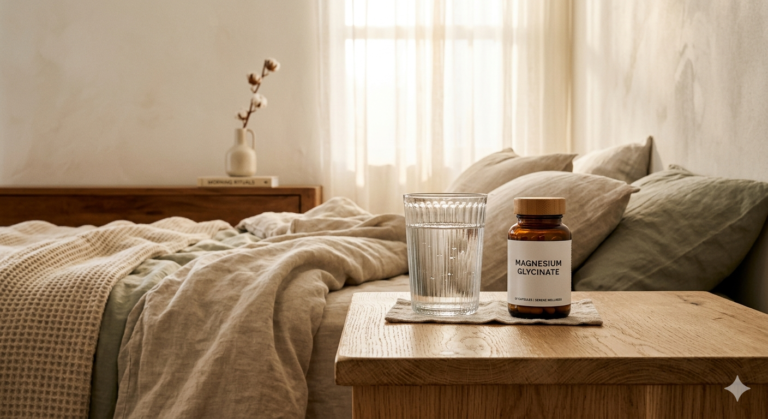
- Magnesium glycinate before bed — supports GABA and the overnight cortisol drop that keeps you asleep
Your Sleep Environment Checklist
Your bedroom should be optimized for sleep — dark, cool, quiet, and associated only with sleep (not work, scrolling, or worry).
🛏️ Bedroom Optimization:
✅ Temperature: 65–68°F (18–20°C)
✅ Darkness: blackout curtains or sleep mask
✅ Quiet: earplugs or white noise machine
✅ Bedding: breathable cotton or bamboo
✅ No phone charging on the nightstand
✅ No TV in the bedroom
✅ Reserve the bed for sleep and intimacy only
Supplements That Support Sleep After 40
Sleep hygiene habits are the foundation. These supplements work best on top of that foundation — not instead of it.
💊 Magnesium Glycinate — Most Recommended
200–400mg elemental magnesium 30–60 minutes before bed. Activates GABA receptors (the brain’s calming system), supports the cortisol drop needed for sleep, and reduces the muscle tension that can prevent deep relaxation. This is the most evidence-backed sleep supplement for women over 40. Glycinate form absorbs best and is gentlest on digestion.
🌿 Ashwagandha — For Stress-Driven Insomnia
300–600mg of KSM-66 or Sensoril extract daily. If your sleep problems are driven primarily by a wired, anxious mind rather than hormonal disruption, ashwagandha addresses the cortisol root cause. Takes 4–8 weeks for full effect. Best taken in the evening.
🍵 L-Theanine — For Racing Mind at Bedtime
100–200mg before bed. Promotes alpha brain waves (calm, relaxed alertness) without sedation. Particularly helpful if your mind races when you lie down. Can be combined with magnesium glycinate for a synergistic effect.
🌙 Melatonin — Use Sparingly and at the Right Dose
0.5–1mg (not 5–10mg) 30–60 minutes before bed. Most melatonin supplements are dramatically overdosed. The effective dose for most adults is 0.5–1mg — higher doses don’t improve sleep and may actually disrupt it. Most useful for jet lag, shift work, or resetting a disrupted schedule — not as an ongoing nightly sleep aid.
When Sleep Problems Need Medical Attention
Sleep hygiene resolves most lifestyle-driven sleep problems. But some situations require medical evaluation:
- Snoring, gasping, or partner-observed pauses in breathing — possible sleep apnea, which is underdiagnosed in women and significantly worsens sleep quality and health
- Restless leg syndrome — uncomfortable sensations in the legs that worsen at night; treatable but requires diagnosis
- Severe night sweats not responding to temperature management — worth a conversation about hormonal options
- Chronic insomnia lasting more than 3 months — Cognitive Behavioral Therapy for Insomnia (CBT-I) has the strongest evidence base of any insomnia treatment, including medication
- Extreme daytime fatigue despite adequate sleep hours — worth checking thyroid, iron, and vitamin D levels
💡 CBT-I: The Most Effective Insomnia Treatment You’ve Never Heard Of
Cognitive Behavioral Therapy for Insomnia (CBT-I) is a structured program that addresses the thoughts and behaviors that perpetuate insomnia. Multiple studies show it is more effective than sleeping pills — and the results last. It’s available through therapists, sleep specialists, and digital programs (Sleepio and CBTI Coach are well-regarded options). If sleep hygiene alone isn’t enough after 4–6 weeks, CBT-I is the evidence-based next step.
Your Complete Sleep Hygiene Action Plan
✅ Start With These — In Order of Impact:
✅ Fix your wake time first — same time every day, 7 days a week
✅ Get morning light within 60 minutes of waking — 10–30 minutes outside
✅ Cool your bedroom to 65–68°F — non-negotiable after 40
✅ Dim lights and screens 60 minutes before bed
✅ Create a 20-minute wind-down ritual — same sequence every night
✅ Cut caffeine by noon (or 2pm latest)
✅ Reduce evening alcohol — even one drink disrupts deep sleep
✅ Exercise daily — but finish intense workouts by 6–7pm
✅ Take magnesium glycinate 200–400mg before bed
✅ Give it 2–4 weeks — sleep responds to consistent habits, not one-off changes
The Bottom Line
Sleep after 40 is harder — but it is not hopeless. The hormonal changes are real, but they don’t mean poor sleep is permanent. The right habits, applied consistently, can dramatically improve both sleep quality and daytime energy.
Start with your wake time and morning light. Add the bedroom environment changes. Build a wind-down ritual. And give the process at least two to four weeks before evaluating — because sleep responds to patterns, not single interventions.
You spend a third of your life asleep. It’s worth getting it right.
Next in the Mind & Body Reset Series → Part 2: How to Manage Daily Stress (Without Overhauling Your Life)
Free Tool
Got a confusing lab result or medical document?
PaperDecoder explains any lab report, supplement label, or medical document in plain English — free, no signup required.
Try PaperDecoder Free →This post is for informational purposes only and does not constitute medical advice. Always consult with a qualified healthcare provider if sleep problems are severe or persistent, especially if you suspect sleep apnea or another sleep disorder.
You might also like:
– Best Magnesium for Sleep: What Women Over 40 Actually Need
– How to Lower Cortisol Naturally: What Actually Works After 40
– Perimenopause Symptoms Checklist: What’s Actually Normal After 40
– HRT for Women Over 40: What the Science Actually Says in 2026